Saving energy is the most direct way to lower your electricity bill — and, as a bonus, it uses fewer natural resources. However, most lists of "tips" on the internet repeat generic advice or suggest foreign apps that don't work here. This text takes the opposite approach: what you can do in Brazil, with what you already have at home.
The correct order is: first understand where your home's energy is going, then change the habits that truly weigh on your bill, and only then think about tools or apps. Below you'll find both—the changes that actually show up on your bill and the apps that a Brazilian consumer can use, along with what each one does and what it doesn't.
How to Save Energy at Home
Daily habits solve a large part of the problem and cost nothing: turning off appliances that are left on when no one is using them, replacing old light bulbs with LEDs, taking advantage of natural light during the day, and not leaving the refrigerator door open while you decide what to eat. These are small actions, but they are repeated every day—and it's the repetition that shows up at the end of the month.
Maintenance also matters. A refrigerator with a dried-out door seal, an air conditioner with a dirty filter, and a shower set to "winter" all year round consume more energy than necessary. Replacing an old appliance with a model rated Procel A usually pays off over the years, but it's a significant expense: it only makes sense when the appliance is nearing the end of its life.
Onde a Energia Vai Embora na Sua Casa
In a typical Brazilian home, energy consumption is concentrated in a few appliances—almost always those that heat or cool something:
- Electric shower — used for a short time each day, but with very high power.
- Air conditioning — the opposite: medium power, running for many hours.
- Refrigerator and freezer — they are plugged in 24 hours a day, every day.
- Iron, dryer, and electric oven — occasional use, heavy consumption.
To give you an idea of the difference in scale: a 15-minute shower with an electric showerhead consumes roughly the same amount of energy as a refrigerator throughout an entire day. This is an approximate calculation, which varies depending on the shower's power and the refrigerator model, but it serves to show where it's worth focusing your efforts. Reducing shower time and using the "summer" setting when the weather permits usually yields more savings than any other household adjustment.
Como Calcular o Consumo de um Aparelho
You don't need any app for this part. Take the appliance's power rating in watts (it's on the label or in the manual), multiply it by the hours of use per day and the number of days in the month, and divide by 1,000. The result is the consumption in kWh. Multiplying this by the kWh price—which is printed on your electricity bill—gives you the approximate cost of that appliance for the month.
It's important to remember two items on your bill that are beyond your direct control: the tariff flag, which is set monthly, and taxes. In months with a red flag, the same consumption costs more, even if you haven't changed anything at home.
Aplicativos e Ferramentas para Acompanhar o Consumo
These are the options that a consumer in Brazil can actually use. Download any app only from your phone's official app store and check if the publisher is the company itself.
1. Your energy distributor's app
It's the most useful and the most ignored. Enel, CPFL, Neoenergia, Light, Cemig, Copel, Equatorial, and other distributors have their own app. Your distributor's name is printed on your bill—search for it in the app store and confirm that the developer is the distributor, not a third party.
In it you can see the second copy of the bill, the reading date, the kWh consumption history for the last few months, and you can report power outages. The history is what matters here: by comparing the months, you can see when consumption increased and associate that with what changed at home. What it normally does no Its function is to show consumption in real time — the data only appears after the meter is read, except where a smart meter is already installed.
2. Smart plug with energy consumption metering
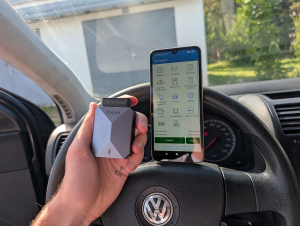
This is where paid hardware comes in. There are smart plugs that measure how much power the plugged-in device is consuming and display this information in the manufacturer's app — the most common models in Brazil work with the Smart Life or Tuya apps. You can see the daily consumption, create schedules, and turn them off remotely.
Two honest limitations: the measurement is approximate, it doesn't have the precision of the utility company's meter; and it only detects what is plugged into that outlet. Electric showers and wall-mounted air conditioners, which are precisely the biggest culprits, are excluded—they are plugged directly into the circuit or draw more current than those outlets can handle.
3. Outlet power consumption meter (wattmeter)
It's not an app, it's a small device that sits between the wall socket and the plug and displays the wattage on a screen. It's also a paid service, but it usually costs less than a smart plug and is good for a quick diagnostic: you move it from appliance to appliance over a few days and find out which ones are actually consuming the most power.
4. Connected home apps (Google Home, Alexa)
They don't measure energy consumption on their own, and it's important to make that clear. What they do is control compatible devices: create routines that turn everything off when you leave, turn off lights by voice command, program the air conditioner to turn off in the middle of the night. The savings come from the appliance that is no longer left on unnecessarily, not from any measurement made by the app.
5. Applications for calculating and simulating consumption
These are apps where you input the appliances you have, their power rating, and how many hours you use each one, and it gives you an estimate of your monthly energy consumption. They function like calculators, not meters: the result is only as accurate as the data you entered. Still, they help you rank the biggest energy consumers in your home without buying anything. If you prefer, you can do the same calculation in a spreadsheet or on paper, using the formula from the previous section.
What These Apps Do — and What They Don't Do
No app installed on your phone can measure your home's energy consumption on its own. For a measurement to occur, someone needs to measure it: either the utility company's meter, a smart plug, or a wattmeter. Any app that promises to show real-time consumption "just by installing it" is, at best, making an estimate based on data you've provided yourself.
Another point: the savings don't come from the app itself, but from the change in habits it helps you identify. The app shows that the freezer in the laundry room consumes energy all day; it's up to you to decide when to turn it off. It's also worth checking the permissions the app requests before installing—an energy consumption app has no reason to ask for access to contacts or messages.
Common questions
1. How can I reduce my energy consumption without spending any money?
Shortening shower times with electric showerheads and using the "summer" setting when possible, turning off appliances that are left on when not in use, adjusting the air conditioning to a less extreme temperature, and taking advantage of natural light. These are the changes that show up on your bill without requiring any purchases.
2. What is the best app for tracking energy consumption?
For most people, the one from their own utility company is free, uses official data from their meter, and shows the monthly history. If you want to see each appliance individually, then you need a smart plug with metering or a wattmeter, which are paid devices.
3. Are energy monitoring apps accurate?
It depends on where the number comes from. The one from the utility company's meter is the official value on your bill. The one from smart plugs is approximate and is used to compare devices, not to verify the bill. And the one from calculator apps is just an estimate based on what you entered.
4. Is there an app that automatically reduces the bill?
No app reduces your bill on its own — it informs you, organizes your plans, and, in the case of a connected home, automates the switching off of appliances. The reduction comes from the energy consumption that no longer occurs.
5. Why did the bill go up if I didn't change anything at home?
It could be the tariff flag for the month, a tariff adjustment, a billing period with more days than the previous one, or a change of season—air conditioning runs much more in January than in July. Comparing the historical kWh usage on the distributor's app, rather than the monetary value, helps to distinguish between the two.
Conclusion
Reducing your electricity bill is less about finding the right app and more about knowing where your energy is going. Start by checking your consumption history on your energy supplier's app, tackle appliances that generate heat or coolness first, and only invest in smart plugs or a wattmeter if you want to see each appliance individually. It's an effort that pays off every month—and, as a bonus, reduces waste.